You don't need to throw out your assignments or ban AI. You need a way to see where an assignment is weak and a reliable way to strengthen it. The Assignment Makeover framework gives you both in four steps: Audit, Anchor, Design, and Align.

1. AUDIT
Start by testing the assignment you already have. Read it the way a student with a chatbot would. What could AI produce in one try? What would it get wrong or skip?
2. ANCHOR
Before you change anything, decide what the assignment is for. What should a student know, do, or be able to show when it's finished. This step keeps a makeover from turning into a gimmick. If a change doesn't serve the learning goal, it doesn't belong.
3. DESIGN
Now you rebuild. Choose one or more of five strategies, depending on your subject, your students, and how you want AI to fit in.
4. ALIGN
A redesigned assignment only works if the goal, the task, and the grading agree. In this step you check the new version against your learning goal and update the rubric so it rewards the thinking you now ask for.
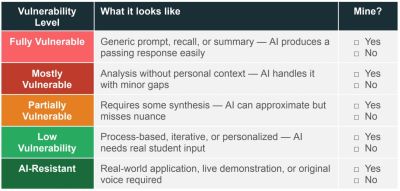
Every assignment falls somewhere on a five-level scale, from easiest for AI to hardest. The goal isn't to push every assignment to the bottom of the scale. It's to know where each one sits and move it as far as makes sense for your course.
Learn more on the AI Vulnerability Spectrum page

AI detectors give uncertain results and can accuse honest students. Redesign works on the cause: an assignment that doesn't require thinking is easy to outsource. When you change the assignment, you stop relying on guesswork.
✓ A framework for designing assignments AI can't complete
✓ A practical instructional design process
✓ A way to make the work you're already doing more defensible
✓ Built for classroom and course use, starting with your next assignment
✕ A tool for catching students using AI
✕ A policy or honor code solution
✕ One more thing to add to your plate
✕ Theoretical or research-only